
For decades, we have organised software development around processes designed to make work plannable, divisible, and manageable across teams. As teams and systems grew more complex, additional layers of management, specialisation, and formal procedures emerged.
Artificial intelligence is challenging this model. Implementation is becoming faster, changes are becoming cheaper, and AI agents can increasingly carry out substantial parts of the work autonomously. Organisational structures, however, are changing much more slowly.
This is not the end of Agile. It is the end of an era in which the prevailing way of organising software development could be taken for granted.
1. Faster Programming Does Not Mean Equally Faster Development
Consider a project in which implementation accounts for 30% of the total development time. The remaining 70% is spent on analysis, decision-making, coordination, testing, and other activities.
If AI makes implementation ten times faster, its time requirement drops from 30 units to 3. The total development time falls from 100 units to 73 — a reduction of approximately 27%. Overall development therefore becomes about 1.37 times faster, not ten times faster.
This is an illustrative calculation, not a universal ratio. The actual result will vary considerably depending on the project, technologies, and working methods. The underlying principle, however, is important: the cheaper implementation becomes, the more significant the cost of everything surrounding it.
The challenge is therefore not simply to write code faster. We need to rethink the entire process through which we turn a problem into a working solution.
2. When Agile Becomes a Process Burden
Agile was intended to bring development closer to the customer, shorten feedback loops, and make it easier to respond to change. The original Agile Manifesto explicitly prioritises individuals and interactions over processes and tools, and responding to change over following a plan [1].
In many organisations, however, an extensive process apparatus has gradually grown around Agile methods. Planning, estimation, meetings, task allocation, reporting, and coordination between teams can consume a substantial share of the time that was meant to be spent solving the actual problem.
This becomes particularly visible in large organisations, where principles that work well in a small team must be adapted to numerous teams, dependencies, and organisational structures. Research into large-scale Agile transformations describes precisely these challenges, including coordination, integration with other organisational functions, and adapting methods to specific organisational contexts [2].
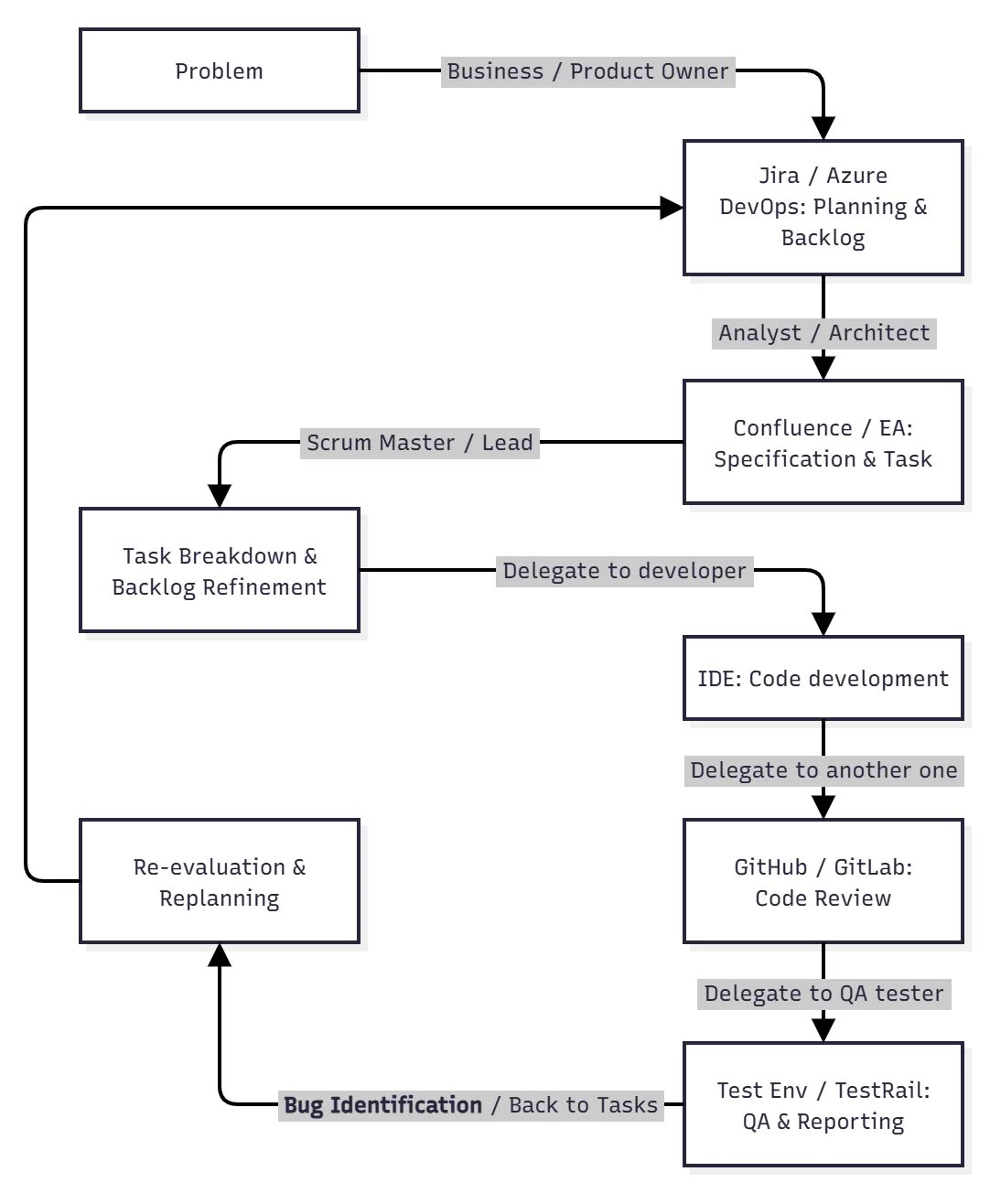
The problem is not that processes have no value. Coordination is unavoidable in larger systems. The question is whether its cost still justifies the value it provides.
A process designed to facilitate change can become an obstacle to making that change.
3. Software Is Not an Automobile on an Assembly Line
We often try to organise software development like mass production. We divide the work into tasks, define their sequence, estimate the effort, and then monitor whether execution matches the plan. This approach works for many repeatable activities, but it does not capture the full nature of software creation.
Software is not a finished physical product repeatedly manufactured from a known design on an assembly line. Creating software is often a creative activity in which the right solution emerges through the process itself.
In some cases, it resembles painting a picture more than manufacturing an automobile. First, the basic composition takes shape. Then details are refined and earlier decisions are revised along the way. A change to one part can affect the whole.
Development may therefore require simultaneous changes to the data model, API, and user interface, while continuously checking whether all the parts work together correctly. Dividing such work among several people can be beneficial, but it can also introduce the cost of transferring context and coordinating changes.
Not every task can be managed effectively as a set of predefined work items. Software development often means discovering the solution through iteration, rather than merely implementing a design that is already complete.
4. AI Is Changing the Economics of Iteration
AI is not just accelerating code generation. It is also reducing the cost of experimentation, rework, and finding better solutions. This changes the economics of iteration: a change that was previously too expensive may now be a sensible way to achieve a better outcome.
Consider a team that discovers halfway through a sprint that a substantial part of its solution needs to be redesigned. In a traditionally organised environment, this may trigger replanning, reprioritisation, and coordination among everyone affected. If half of the implementation needs to be reworked, a significant portion of the sprint may be spent repeating work and reorganising it.
With AI, the rework itself can become much cheaper. But if every change still requires the same amount of coordination, part of the potential saving disappears.
The 2025 DORA research report describes AI as an amplifier of existing organisational capabilities and weaknesses: the benefits depend not only on the tools themselves, but also on the quality of the system in which they are used [3].

The advantage will go to teams that can test ideas and refine solutions quickly, without unnecessary process friction. Planning will remain important, but not every step will need to be planned in as much detail as before.
5. The Division of Work and the Boundaries Between Roles Are Changing
AI is gradually entering different parts of software development. It can help explore an existing system, clarify requirements, propose solutions, implement them, and verify their correctness. Activities that were previously divided among specialised roles can increasingly take place within a single, connected workflow.
This does not mean specialisation will disappear. It means that existing boundaries between activities, and the formal handoffs between them, may no longer be the most effective way to organise the work.
The change also affects the relationship between IT and the rest of the organisation. Someone who understands a particular problem can now use AI to build a small application, script, or automation without going through the entire central development process. For larger systems, sound architecture, security, and clear accountability remain essential. Smaller needs, however, can often be addressed much closer to where they arise.
Organisations will need to reconsider not only how quickly work is done, but also which activities genuinely require specialised handoffs and which can be combined into more autonomous units.
6. Smaller Teams Are Not Enough. Software Itself Must Be Structured Differently
One possible response is to form small teams that communicate directly and do not need an elaborate coordination process for every change. But simply reducing team size is not enough. We cannot rely exclusively on a handful of exceptionally capable generalists — and AI cannot work reliably without well-prepared context either.
The key is to structure the system so that both people and AI can work autonomously without every change putting the integrity of the whole at risk.
One possible approach is a two-layer model, L1 + L2. Layer L1 provides the technical foundation: reusable components, established patterns, and an architectural skeleton. Layer L2 assembles these building blocks into a specific application and implements its business-specific logic.

This separates recurring technical complexity from the parts that change according to the needs of a particular product. AI is given clear patterns and boundaries within which to operate, rather than having to redesign the structure of the entire system for every new feature.
The goal is not to eliminate architectural decision-making, but to make those decisions well once and benefit from them throughout subsequent iterations. Structuring complexity in this way is one of the prerequisites for increasing AI autonomy without allowing system complexity to grow uncontrollably.
7. From Managing Processes to Defining Intent
The traditional way of organising software development is not losing relevance because planning, collaboration, or Agile are inherently wrong. It is losing its privileged position because the economic assumptions on which the model rests are changing.
If implementing and reworking solutions becomes substantially cheaper, it no longer makes sense to preserve unchanged an organisational structure that emerged when technical work was slower and more expensive.
In the new model, the human primarily defines the intent, domain rules, architectural boundaries, and criteria for correctness. AI can independently implement, test, and improve the solution within those constraints. Responsibility for direction and the consequences of decisions, however, remains with people.
The future does not necessarily mean less discipline, but a different kind of discipline: less effort spent managing individual steps, and more attention devoted to architectural quality, clarity of intent, and the ability to verify results quickly.
AI is not just making programming cheaper. It is forcing us to rethink how software development itself should be organised.
References and Further Reading:
- Manifesto for Agile Software Development (2001). The original values and principles of Agile.
- Dikert, K., Paasivaara, M., Lassenius, C. Challenges and Success Factors for Large-Scale Agile Transformations: A Systematic Literature Review. Journal of Systems and Software, 2016. A systematic review of experience with Agile transformations in large organisations.
- DORA. The State of AI-Assisted Software Development (2025). Research into the relationship between AI, organisational capabilities, and software delivery performance.
- Cui, K. Z. et al. The Effects of Generative AI on High-Skilled Work: Evidence from Three Field Experiments with Software Developers. Management Science, 2026. Results from three experiments involving AI tools and 4,867 developers; the results varied across experiments.
- Unpredictable Machine. The Unpredictable Machine Manifesto (2026). Research platform for AI-driven development and the thesis behind this series.
- Unpredictable Machine. Delegating Responsibility to Agents (2026). System complexity evolution when delegating codebase management to autonomous AI agents.